
Hands-on review · 0.1.0-rc.6
DeepSeek Harness Review: Plugins, Profiles, Pros & Cons
A hands-on review of DeepSeek Harness 0.1 developer preview: installation, plugin architecture, profiles, Web UI, strengths, limitations, and who should use it today.
- Author
- DeepSeekAgent.io Editorial Team
- Published
- Updated
Disclosure: deepseekagent.io documents and links to the community-maintained DSH Desktop. This review evaluates the official upstream Harness separately and states the limits of our testing.
Version note · 11 Sep 2026: the hands-on baseline remains rc.6. npm latest now points to v0.1.5-rc.1, next to v0.1.5-rc.2, and alpha to v0.1.5-alpha.2. The original rc.6 test remains clearly labeled and has not been presented as a retest of these builds.
Verdict first
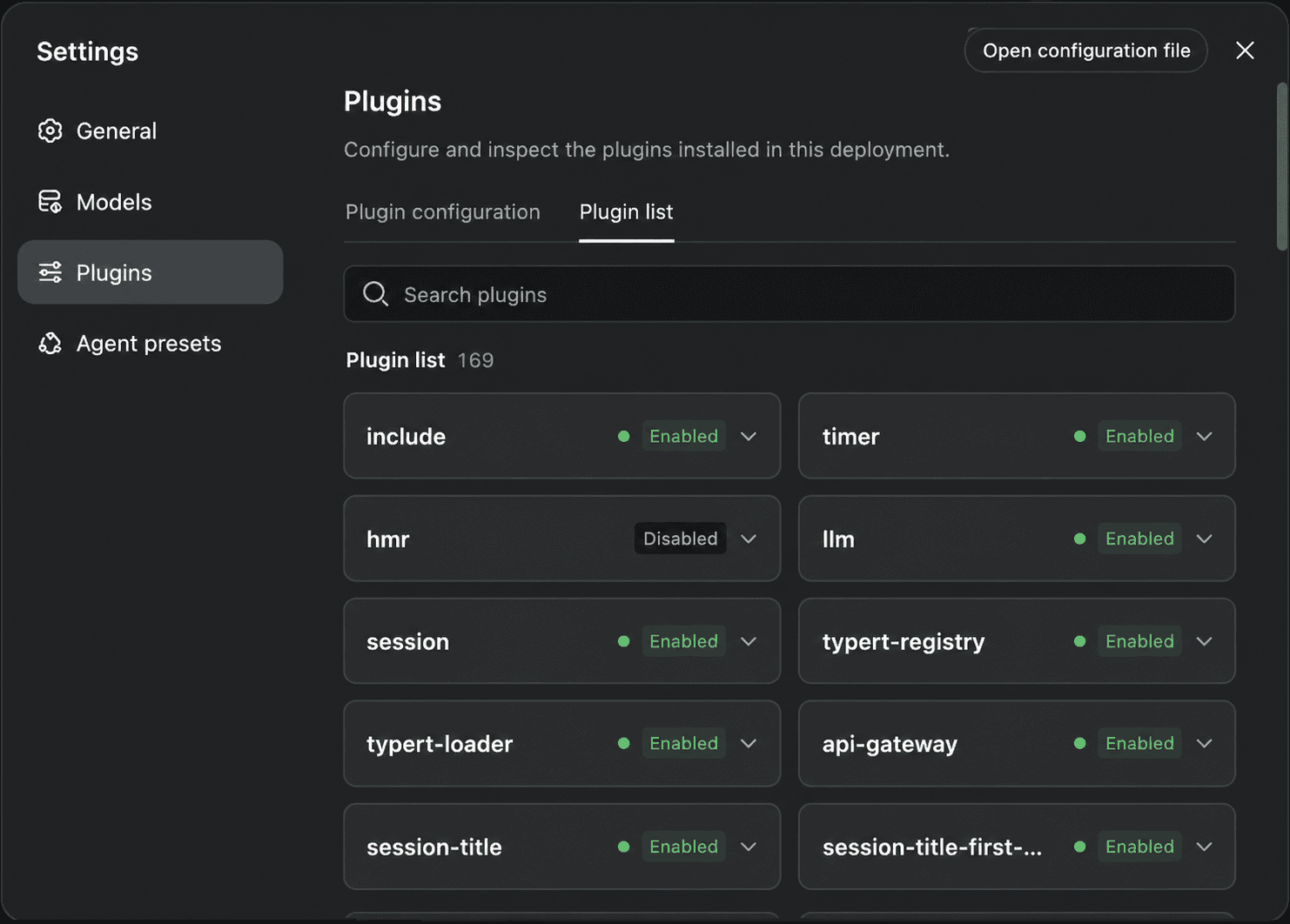
DeepSeek Harness matters less as “another coding agent” than as an attempt to make the agent itself composable. Model adapters, tools, context, session records, subagents, the interface, and even the agent loop can participate in a plugin tree instead of living behind a privileged core.
That direction is compelling for agent-platform builders, researchers, and developers who want to shape their own runtime. It is less compelling—at least in the 0.1 developer preview—for someone who only wants a polished replacement for Codex or Claude Code.
Our verdict: the architecture is genuinely interesting and useful for experimentation, but the current product is better treated as a platform to explore than a default tool for every production team.
| Area | Assessment |
|---|---|
| Architectural originality | Strong; plugins compose the runtime rather than merely decorating it |
| First launch | Simple through npm, with deeper concepts waiting underneath |
| Default experience | Accessible Web UI, with visible developer-preview edges |
| Extensibility | The clearest advantage |
| Stability expectation | Do not evaluate it as a mature, compatibility-stable product |
| Best for | Agent builders, plugin authors, research, internal platforms |
| Not yet ideal for | People who want a zero-maintenance finished coding agent |
What we actually tested
This review uses @deepseek-ai/[email protected] with a pinned Node 24.19.0 runtime. We performed the following reproducible checks:
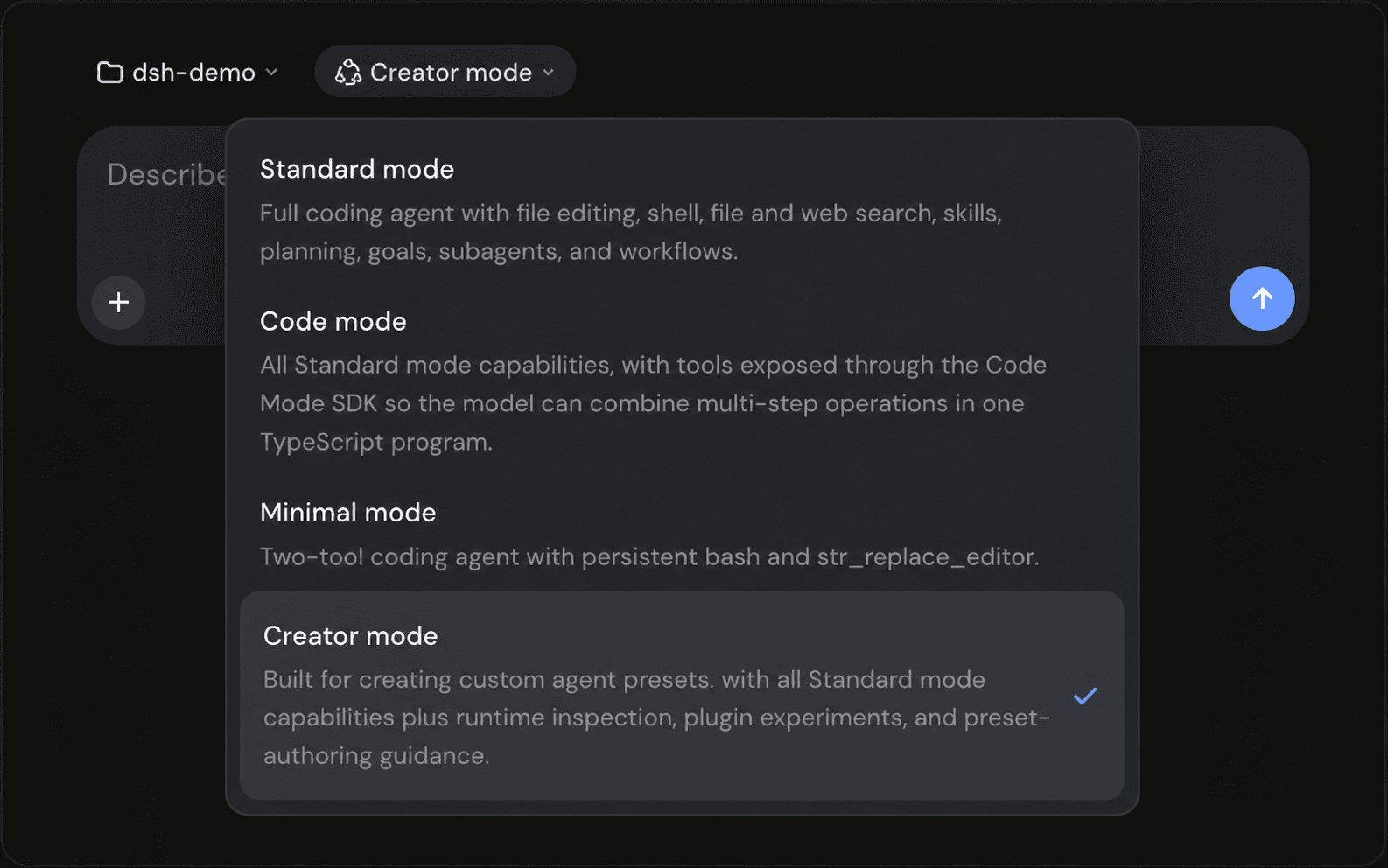
The mode labeled Code Mode in this rc.6 test was renamed PTC Mode in the v0.1.2-alpha.1 GitHub pre-release, with older session records remaining readable. References to the tested interface below retain the rc.6 terminology and do not imply an alpha.1 retest.
- Executed the bundled runtime and confirmed
dsh --versionreturns0.1.0-rc.6. - Inspected the
web,headless,plugin,--profile,--patch, and configuration-dump CLI paths. - Verified how web and headless profiles initialize from shipped templates.
- Inspected the composition order for bundle patches, profile overrides, machine-level overrides, and command-line overlays.
- Examined the installed packages for tools, trajectory UI, retry behavior, subagent control, workflows, model selection, and sandboxing.
- Confirmed that the bundled Node runtime can execute the pinned DeepSeek Harness package independently of a system Node installation.
We did not publish a model-performance leaderboard in this revision. Agent results depend on the exact model, provider, system prompt, profile, tool surface, and task set. Without a fixed public benchmark and complete token accounting, a single “success rate” would create false precision. A coding-task benchmark belongs in a separately reproducible update.
Installation: a simple doorway into a complex system
The official shortest path is one command:
npx @deepseek-ai/dsh web
It starts a local Web UI, making first contact much easier than building the repository from source.
Underneath that simple command, DeepSeek Harness is not a one-config CLI. Its central abstraction is the profile: an ordered set of plugin bundles, a profile patch, and user or machine overlays. The web and headless profiles initialize automatically; custom profiles ask you to understand plugin dependencies and configuration composition.
The trade-off is clear:
- Running the default experience is approachable.
- Using the architecture’s full power has a higher learning curve than “paste an API key and choose a model.”
“Everything is a plugin” is more than ordinary plugin marketing
Many developer tools support extensions, but those extensions usually add commands, hooks, or external tools around a fixed product. DeepSeek Harness lets plugins participate in the runtime itself.
From the installed package layout and profile system, the composable surface includes:
- model adapters and selection
- shell, editing, and search tools
- jobs, workflows, and subagent control
- LLM retry and output retention
- session trajectory and UI features
- sandbox policy
- application entry points and modes
It feels more like a runtime for constructing agents than a finished agent with a few extension slots.
That enables a team to package internal permissions, tools, prompts, and audit behavior into a profile. It also means failures may come from plugin versions, patch order, or configuration overrides—not only from the model. --dump-default-config and --dump-config are therefore operationally important, not obscure debugging flags.
Web, headless, and profiles
dsh web is the most visible entry point, but the design is more important than the interface.
The headless profile can run a fresh persisted task, print the final response, and exit, which fits scripts, CI, and batch jobs. Custom profiles can freeze a team’s tool and policy stack while preserving machine- or task-level overlays.
This is more engineering-oriented than toggling features in a settings screen and potentially more reproducible for teams. It also exposes complexity that mature consumer coding agents usually hide.
How it differs from Codex, Claude Code, and OpenCode
| Dimension | DeepSeek Harness | Codex / Claude Code | Open clients such as OpenCode |
|---|---|---|---|
| Product center | Compose and build an agent runtime | Complete coding tasks | Open providers and interaction |
| Extension depth | Can reach the agent loop and app layer | Primarily skills, MCP, and hooks | Providers, plugins, or tools |
| Default maturity | Developer preview | More mature | Varies by project |
| Configuration | Powerful and correspondingly complex | Simpler default path | Usually somewhere between |
| Best fit | Build your own agent shape | Daily coding delivery | Multi-model, open workflows |
“Can DeepSeek Harness replace Codex?” is therefore not the best first question. Ask whether you need control over how the agent is assembled. If not, a mature product is usually easier. If yes, DeepSeek Harness exposes a much deeper seam.
What we like
1. The architecture matches the claim
“Everything is a Plugin” is visible in the package and profile structure rather than existing only in launch copy.
2. The final configuration can be inspected
Layered patches are complex, but DeepSeek Harness provides a way to dump the composed result. That matters when a team needs to explain why two machines behave differently.
3. Interactive and automated use share one model
Web and headless are profiles rather than disconnected products. That leaves a credible path toward CI agents, internal review agents, and purpose-built workflows.
4. It is friendly to experimentation
Making the tool surface, context policy, and agent loop configurable gives researchers more visibility than a closed coding product.
Current limitations
1. Developer preview means compatibility risk
The official project explicitly warns about breaking changes. Plugins, profiles, and deployment scripts written today need an upgrade budget.
2. There are many concepts
Profiles, bundles, Cordis patches, user overrides, command-line overlays, and plugin dependencies all shape the final runtime. The power is real, but the mental model takes time.
3. The debugging surface grows
Traditional agent failures already involve models, permissions, tools, and networks. DeepSeek Harness adds plugin composition and configuration precedence, increasing the need for diagnostics and shared practices.
4. The ecosystem is still forming
A plugin architecture succeeds through documentation, compatibility, discovery, maintainership, and excellent third-party plugins—not through interfaces alone. It is too early to call the ecosystem mature.
5. Harness quality is not automatically model quality
Orchestration can improve some tasks, but coding quality still depends on the model, context, prompt, tools, and job. A sophisticated harness does not prove higher task success without a controlled comparison.
Who should use it now?
Try it now if you are:
- studying agent-harness architecture
- building an internal agent platform
- packaging permissions, tools, and workflow into reproducible profiles
- writing DeepSeek Harness plugins or experimenting with tool surfaces
- comfortable following rapid releases and configuration changes
Wait if you:
- only need a stable daily coding agent
- cannot absorb configuration migrations in production
- expect mature documentation and support for every plugin
- assume an official harness must outperform every alternative on every task
Final assessment
DeepSeek Harness exposes parts of an agent that finished products normally keep internal and turns them into a programmable composition system. That makes it feel more like infrastructure than another coding-agent shell.
Our recommendation is neither “replace Codex today” nor “ignore it until 1.0.” Use it now to test profiles and plugins on real repositories, while delaying production migration until its interfaces and ecosystem stabilize.
Read our installation guide to run it, compare it with Codex, Claude Code, Hermes Agent, and OpenCode, or see the community-maintained DSH Desktop if you want a bundled runtime. For the current developer-preview warning and installation command, refer to the official DeepSeek Harness repository.